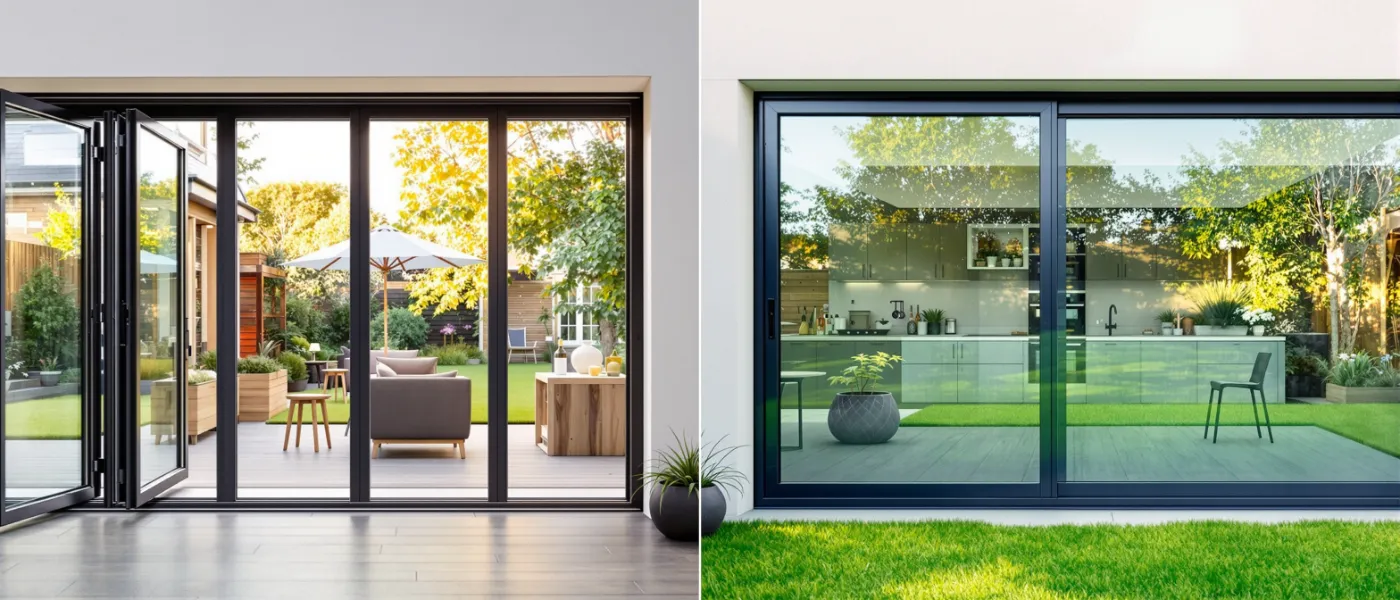
Every London rear extension, kitchen renovation, and garden-room project faces the same critical decision: bifold doors or sliding doors? Both systems flood interiors with natural light, erase the boundary between inside and out, and add significant value to London properties. But they achieve this through fundamentally different engineering, with major implications for cost, thermal performance, usable space, security, and long-term repair costs.
This guide provides a direct, honest comparison written for London's specific context — period property constraints, conservation area rules, compact gardens, and the city's premium labour and material costs. No manufacturer bias. Just the facts you need to choose correctly.
Quick comparison table
| Factor | Bifold doors | Sliding doors |
|---|---|---|
| Maximum opening | 90–95% of total width | 50–66% of total width (1–2 panels sliding) |
| Frame sightlines | Wider (132–178mm per panel) | Slimmer (20–35mm per panel) |
| Typical cost (3.0m aluminium) | £3,500–£8,000 | £2,500–£6,000 |
| Thermal performance | Good (more frame = more heat loss) | Excellent (less frame, larger glass) |
| Repair complexity | Higher (hinges, pivots, multiple locks) | Lower (rollers, single track, fewer locks) |
| Repair cost (typical) | £200–£600 | £120–£400 |
| Security | Good (multi-point on every panel) | Very good (fewer weak points) |
| Best for | Entertaining, wide openings, full access | Views, thermal performance, lower maintenance |
Need a verified London specialist for your door?
Describe your problem and receive 3-5 itemised quotes from verified, insured specialists in your area. Free, no obligation.
Bifold doors: pros, cons, and use cases
Pros
Maximum opening: When fully folded back, bifold doors open almost the entire wall. For London homes where garden access and entertaining are priorities, this is unmatched.
Flexible ventilation: You can open a single "traffic door" panel for everyday access without folding the entire system. Or fold back three panels and leave two in place for partial opening.
Aesthetic flexibility: Bifolds suit both modern and traditional properties. Timber-look aluminium systems replicate period French door aesthetics with modern performance.
Internal/external use: Bifolds work brilliantly as internal room dividers in London loft conversions and open-plan layouts.
Cons
Higher frame-to-glass ratio: Every panel has a frame. A 3.0m bifold with five panels has significantly more visible frame than a two-panel slider of the same width, reducing views and increasing thermal bridging.
Stacking space required: Folded panels stack internally or externally, consuming 300–450mm of space. In narrow London gardens or small terraces, this can be intrusive.
More complex hardware: Hinges, pivot points, guide tracks, and multiple locking points mean more failure modes. Repair costs average 40–60% higher than sliding door repairs.
Higher cost: For equivalent width and quality, bifolds typically cost 25–40% more than sliders. A premium 3.0m Origin bifold system starts at £5,500; an equivalent Schuco slider starts at £4,000.
Typical London cost: £3,500–£12,000
Budget uPVC bifolds from national installers (Everest, Safestyle): £3,500–£5,500. Mid-range aluminium (Smart Systems, Reynaers): £5,000–£8,000. Premium systems (Origin, Schuco, Sieger): £7,000–£12,000+. Prices include installation. Premium brands justify their cost through tighter tolerances, better hardware, and 20-year frame guarantees. For further cost comparisons and saving strategies, see MoneySavingExpert's home improvement guides.
Sliding doors: pros, cons, and use cases
Pros
Uninterrupted views: Ultra-slim sightlines (as low as 20mm on premium systems) mean maximum glass and minimum frame. For London homes with garden views, this is a decisive advantage.
Superior thermal performance: Fewer frame sections and better compression sealing mean lower U-values. Premium sliding doors consistently outperform equivalent bifolds on energy ratings.
Lower maintenance and repair costs: Simpler mechanism (track + rollers) means fewer failure points. Roller replacement (£80–£180) is simpler and cheaper than bifold hinge or pivot repair (£150–£400).
No stacking intrusion: Panels slide parallel to the wall rather than folding into the room or garden. Ideal for narrow London gardens, balconies, and terraces where every centimetre counts.
Cons
Limited opening width: Even with a triple slider, you typically achieve only 60–66% open aperture. If you regularly host garden parties or want true indoor-outdoor living, this constraint matters.
Panel weight: Large glass panels on premium sliders can weigh 150–250kg each. This requires heavy-duty rollers and precise installation. Incorrect specification leads to premature roller failure.
Less flexible ventilation: You cannot partially open a large section without exposing a significant opening. A traffic door (integrated side-hung panel) solves this but adds cost and complexity.
Typical London cost: £1,500–£8,000
Budget uPVC single/double sliders: £1,500–£2,800. Mid-range aluminium (Smart Systems, Reynaers): £2,500–£5,000. Premium lift-and-slide (Schuco, Siegenia): £4,000–£8,000+. The cost gap between mid-range and premium is significant but justified by smoother operation, better seals, and 20+ year hardware lifespan.
Need a verified London specialist for your door?
Describe your problem and receive 3-5 itemised quotes from verified, insured specialists in your area. Free, no obligation.
London-specific considerations
Period properties and conservation areas
Many London boroughs — Westminster, Kensington & Chelsea, Camden, Islington — have strict conservation and Article 4 rules. Bifolds with chunky aluminium frames are often rejected for street-facing elevations. Sliding doors with ultra-slim sightlines or timber-clad aluminium are more likely to gain approval. Always pre-consult your planning department — or review UK planning permission guidance for details on permitted development rights.
Compact London gardens
The average London garden is under 50 square metres. Bifold stacking panels consume 0.5–1.0 square metres of usable patio space when folded. Sliding doors preserve this space. If your garden is small, sliding doors are the pragmatic choice unless you absolutely need the full opening for entertaining.
Modern flats and balconies
Balcony doors in London flats are typically 1.2–1.8m wide — too narrow for bifolds to make sense. Single or double sliding doors are the standard and optimal choice. Juliet balconies with floor-to-ceiling sliding glass are increasingly popular in new-build developments for maximising light in compact spaces.
Thermal regulations and energy costs
With London energy costs remaining high in 2026, thermal performance matters more than ever. Sliding doors consistently achieve better U-values than equivalent-width bifolds due to lower frame-to-glass ratios. For north-facing rooms and poorly insulated Victorian properties, this difference translates to measurable heating bill reductions.
Verdict matrix: choose bifold if... / choose sliding if...
Choose bifold if:
- You host garden parties and need the full wall open
- Your opening is 3.0m+ and you want maximum access
- You want flexible partial opening (traffic door mode)
- Internal room division is part of your design
- Budget is secondary to aesthetic flexibility
Choose sliding if:
- Uninterrupted views and slim sightlines are priorities
- Thermal performance and energy efficiency matter
- Your garden or balcony is compact
- Lower long-term maintenance costs are important
- You are in a conservation area with strict sightline rules
Summary
Neither system is universally superior. Bifold doors deliver unmatched opening width and flexible access — ideal for entertainers, wide extensions, and properties where the garden is a true outdoor room. Sliding doors offer better views, thermal performance, lower maintenance, and space efficiency — ideal for compact London plots, energy-conscious homeowners, and conservation-sensitive properties.
For most London homeowners undertaking a standard rear extension (2.5–3.5m opening), the decision comes down to priority: garden access (bifold) or view/efficiency (sliding). Budget typically favours sliding by 25–40%. Repair costs over 15 years favour sliding by a similar margin.
SDR London's verified specialists install and repair both systems across all London boroughs. If you are undecided, request a free consultation where an experienced engineer assesses your opening, discusses your usage patterns, and provides itemised quotes for both options.
Need a verified London specialist for your door?
Describe your problem and receive 3-5 itemised quotes from verified, insured specialists in your area. Free, no obligation.